- Research use only
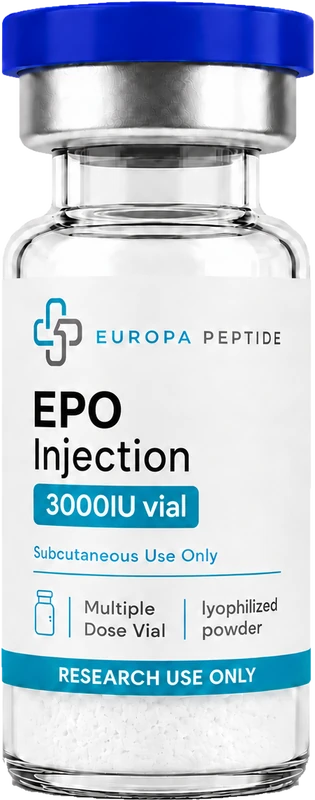
EPO 3000IU
-
Processed as soon as payment clears
Packed and dispatched without delay.
-
Free shipping over €99.00 to most EU countries
-
Shipment protection included
Lost or damaged in transit? We send a replacement.
-
Discreet packaging
Plain parcel, no product names on the outside.
-
We accept
Secure checkout
- SEPA bank transfer
Independent lab results
Tested before it reaches your bench
Certificate on request
The certificate for this product’s current batch isn’t published online yet. Contact us and we’ll send it to you.
Technical specifications
Compound at a glance
Molecular profile
EPO 3000IU
- Compound class
- Erythropoiesis-stimulating glycoprotein
- CAS number
- 113427-24-0
- Molecular weight
- ~30.4 kDa
- Amino acids
- 165 aa
- Research area
- Haematopoiesis research
Handling
Storage and stability
- −20 °C as powder
- 2–8 °C in solution
- Protect from light
- Keep dry
Lyophilised powder
−20 °C, protected from light and moisture
In solution
2 to 8 °C
General guidance for laboratory storage. Follow your institution’s handling procedures.
About this compound
EPO 3000 IU - Erythropoietin for Hematology & Cellular Oxygenation Research
- Composition: 3000 IU Erythropoietin / EPO (lyophilized powder)
- Category: Glycoprotein Hormone
- Form: Multi-dose vial with freeze-dried powder
What is EPO?
EPO, also known as erythropoietin, is a glycoprotein hormone widely studied for its role in red blood cell formation, oxygen transport, hematopoiesis, and cellular oxygen regulation.
It is primarily associated with erythroid progenitor cell activity and is highly relevant in research models focused on hematology, tissue oxygenation, and hypoxia-related signaling pathways.
Unlike peptides primarily focused on metabolic, growth hormone, or immune signaling pathways, EPO is mainly investigated for its effects on erythropoietin receptor activation, erythropoiesis regulation, and oxygen delivery mechanisms. In research settings, EPO has shown relevance in hematology research, hypoxia response studies, and cellular protection pathways.
Relevant for hematology research, erythropoiesis, oxygen transport, and hypoxia-related signaling.
Key Research Insights
Erythropoiesis Research: Studied for its role in red blood cell formation and erythroid progenitor cell development.
Oxygen Transport: Investigated in research models related to oxygen delivery, tissue oxygenation, and blood-related biomarkers.
Hypoxia Response Research: Relevant in studies focused on cellular adaptation to low-oxygen environments and hypoxia-associated signaling.
Cellular Protection: Explored for its potential role in tissue protection, cellular stress response, and recovery-related pathways.
Storage Guidelines
- Store at 2-8 °C (36-46 °F).
- Protect from light and moisture.
- Do not freeze.
- Avoid temperature fluctuations.
Why Choose EPO?
EPO is regarded as a highly relevant glycoprotein hormone for hematology and oxygenation-related research.
Its well-documented biological profile, role in erythropoietic signaling, and importance in oxygen transport research make it a valuable research tool for studies focusing on erythropoiesis, hypoxia response, cellular protection, and hematological science.
Order EPO 3000 IU - and advance your research in hematology, oxygen transport, erythropoiesis, and cellular oxygenation science.
Research notice
For laboratory research use only. This product is not a medicinal product or a food. It is not intended for human or veterinary use, or for any diagnostic or therapeutic purpose.
The buyer is responsible for receiving, storing, handling and disposing of this material safely and lawfully, in line with the rules of their country and institution. We sell only to adults aged 18 or over who are qualified to work with research materials.
Descriptions on this page summarise published research for educational purposes. They are not medical advice and make no claim about safety or effects in humans.